
The car’s “heart”—the engine—houses countless intricate designs and complex structures that work in tandem to deliver the power that propels a vehicle forward. Today, we’ll embark on an exploration to break down key components of the car engine, demystifying its inner workings.
Crankshaft-Connecting Rod Mechanism: The “Cradle” of Power Generation
As the engine’s core, the crankshaft-connecting rod mechanism is the linchpin of power conversion. It acts like a precision power factory, transforming the energy from fuel combustion into mechanical energy that drives the car.
Engine Block Assembly: The Engine’s Sturdy “Skeleton”
The engine block assembly is the engine’s rigid framework, consisting of the cylinder block, cylinder head, head gasket, and oil pan.
Cylinder block: The mounting base for all engine mechanisms and systems. Its internal cylinders provide the space for air-fuel mixture combustion and gas expansion—the “birthplace” of power.
Cylinder head: Seals tightly atop the cylinder block, forming the combustion chamber with the piston top and cylinder walls to create an optimal environment for combustion.
Head gasket: A small but critical component that seals the gap between the cylinder block and head, preventing leaks of gas, coolant, or oil to ensure stable engine operation.
Oil pan: Located at the bottom, it stores engine oil and seals the crankcase, supporting the engine’s lubrication system.
Piston-Connecting Rod Assembly: The “Relay Team” of Power Transfer
The piston-connecting rod assembly functions like an efficient relay team, comprising the piston, piston rings, piston pin, and connecting rod.
Piston: Bears the high pressure of combustion gases, transferring force to the connecting rod (via the piston pin) and ultimately to the crankshaft.
Piston rings: Compression rings seal the cylinder to prevent combustion gas leakage into the crankcase; oil rings scrape excess oil from cylinder walls to avoid oil entering the combustion chamber.
Piston pin: Links the piston and connecting rod, ensuring smooth power transfer.
Connecting rod: Converts the piston’s reciprocating motion into the crankshaft’s rotational motion, keeping the engine running.
Crankshaft-Flywheel Assembly: The “Commander” of Power Output
The crankshaft-flywheel assembly is the hub of power output, including the crankshaft, flywheel, and torsional damper.
Crankshaft: Converts the piston’s reciprocating motion into rotational motion and delivers power.
Flywheel: Mounted on the crankshaft’s rear end, it acts as an energy reservoir—smoothing engine operation and transferring power to the transmission (via the clutch) to provide stable driving power.
Valve Train: The Engine’s “Respiratory Control Center”
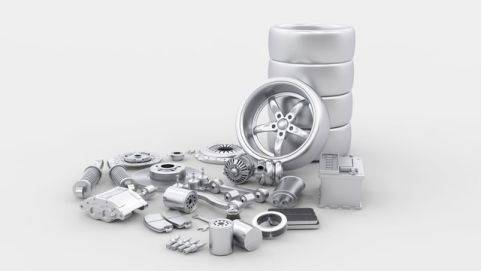
The valve train plays a vital role as the engine’s “respiratory regulator,” precisely controlling the opening and closing of intake/exhaust valves (based on the engine’s cycle and firing order) to let fresh air-fuel mixture/air enter the cylinders and exhaust gases exit—ensuring the engine “breathes” smoothly.
Valve Group: The “Gatekeepers” of Gas Flow
The valve group (valves, valve guides, valve seats, and valve springs) acts as the gatekeeper for gas flow:
Valves: Split into intake and exhaust valves, responsible for gas entry and exit.
Valve guide: Guides the valve’s movement for precise operation.
Valve seat: Seals tightly with the valve to prevent gas leaks.
Valve spring: Keeps the valve closed and ensures a tight seal with the valve seat.
Valve Drive Group: The “Behind-the-Scenes Strategists” of Precision Control
The valve drive group (camshaft, tappets, pushrods, and rocker arms) is the brain behind precise valve operation:
Camshaft: Its cam profiles dictate valve timing and lift.
Tappets, pushrods, and rocker arms: Transmit the camshaft’s motion to the valves—tappets sense cam movement, pushrods relay it, and rocker arms pivot to open/close valves, maintaining the engine’s precise “breathing rhythm.”
Fuel Supply System: The Engine’s “Energy Refueling Station”
The fuel supply system acts as the engine’s energy hub, mixing the right amount of fuel and air (based on engine operating conditions) to form a combustible mixture and delivering it to the cylinders—providing continuous energy for engine operation. It is divided into gasoline and diesel engine systems.
Gasoline Engine Fuel Supply System: A “Precision Energy Cocktail”
Comprising the fuel tank, fuel pump, fuel filter, pressure regulator, injectors, and intake manifold:
Fuel waits in the tank; the fuel pump (a “hardworking porter”) draws it out, filters it (via the fuel filter), and the pressure regulator maintains stable fuel pressure.
Injectors spray fuel into the intake manifold, where it mixes fully with air—like a finely crafted “energy cocktail”—before entering the cylinder.
Diesel Engine Fuel Supply System: A “High-Pressure Energy Projectile Launcher”
Comprising the fuel tank, fuel filter, transfer pump, high-pressure pump, and injectors:
Unlike gasoline engines, diesel is injected directly into the cylinder (via the high-pressure pump) at the end of the compression stroke. It self-ignites under high temperature and pressure, releasing powerful energy—like launching a high-pressure “energy projectile” to power the engine.
Today, we’ve explored the crankshaft-connecting rod mechanism, valve train, and fuel supply system—the foundations of engine operation. But the engine’s secrets don’t end here. In Part 2, we’ll dive into the ignition, cooling, lubrication, and starting systems to see how they work together to keep the engine “heart” beating steadily. Stay tuned!